A remote connection keeps maintenance cheap. An ungoverned one can put the cold chain at risk. Europe’s refrigeration incidents show where product security becomes physical safety.
From remote access to cold-chain disruption
Pictor Consulting · 30 seconds · English
Illustrative overview. Figures and temperature claims in the video come from media reporting, not ENISA’s confirmed incident totals.Open video separately
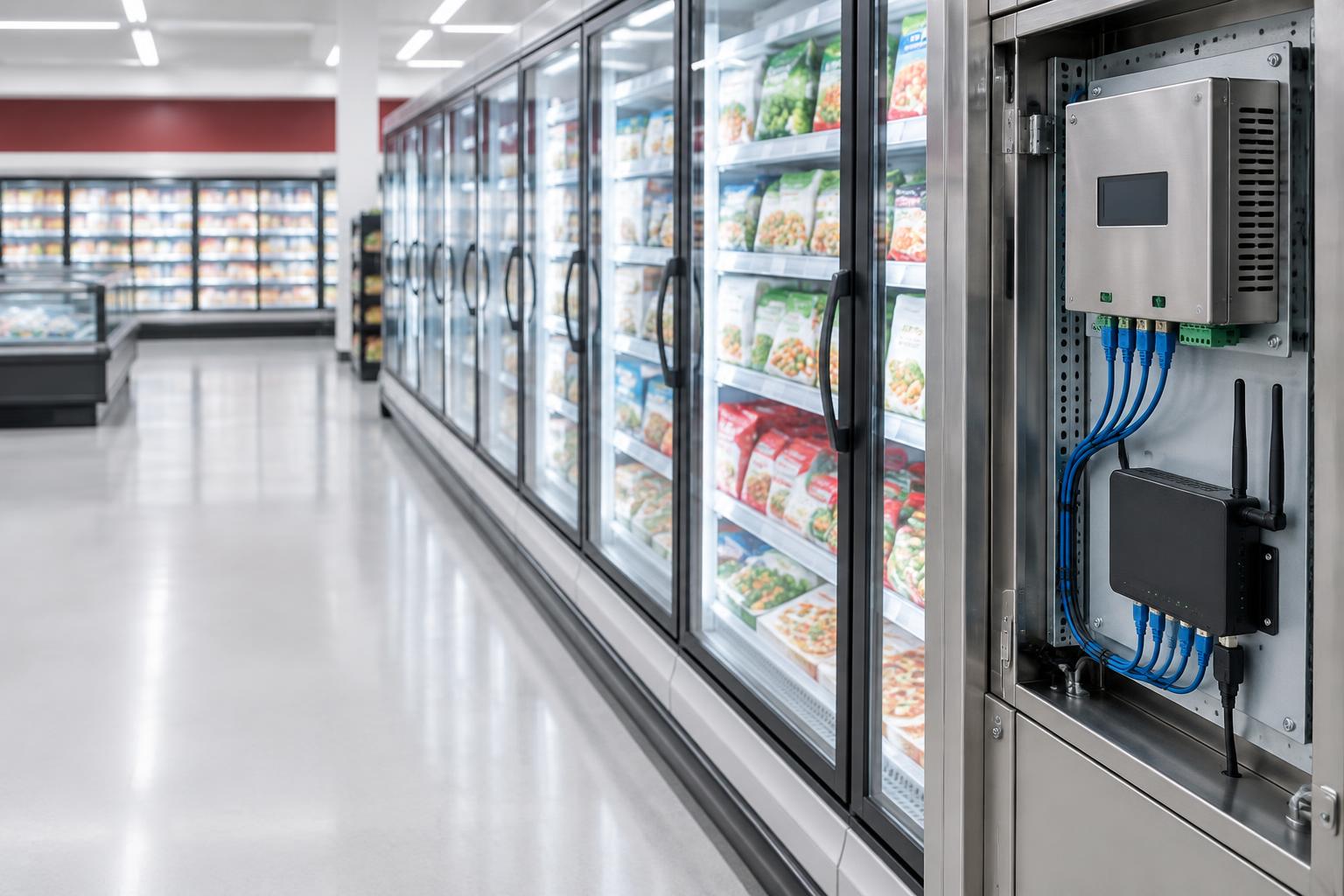
AI-generated illustration of connected refrigeration equipment — not a photograph of the reported incidents.
A freezer does not look like a cybersecurity problem. It looks like a temperature, a service contract and a machine that should keep working while everybody sleeps. But add a remotely accessible controller and the question changes: who can change that temperature, through which connection, and who would notice?
The European refrigeration incidents of October and November 2026 make that question urgent. They are not a story about household fridges. They concern commercial refrigeration systems and similar devices — equipment whose digital controls have direct consequences for goods, continuity and potentially safety.
What is confirmed — and what is still being investigated
In a joint statement published on 4 November 2026, ENISA and the European Commission confirmed that several commercial refrigeration systems and similar devices had been affected by cybersecurity incidents across a number of EU Member States since 11 October. A further wave occurred on 1–2 November. National authorities are investigating, while EU incident-response networks exchange information and coordinate the response.
The statement calls for immediate action to reduce exposure. It does not establish a single attack route, name the affected controller models or confirm the store counts, temperatures and fire reports circulating in the media. Pictor Consulting’s November quick study brings those reports together, but they must remain attributed reports, not settled technical findings.
The engineering lesson does not depend on the final incident count: a maintenance interface is also a control interface.
The hidden door: remote access outside the security boundary
Consider a plausible installation, not a confirmed reconstruction of these attacks. A refrigeration contractor installs a cellular router so technicians can maintain a controller without travelling to the store. The arrangement is convenient. It may also create a separate route into the equipment that the store’s IT team does not inventory, approve or monitor.
If the router has a public IP address and exposes the controller’s administration interface — for example through port forwarding — the device can become reachable directly from the internet. The store’s main firewall may be irrelevant to that route. A network diagram that shows only the corporate connection will miss the most important connection in the room.
4G or 5G is not inherently the vulnerability. Cellular connectivity can be part of a secure design. The risk is unmanaged exposure combined with weak authentication, vulnerable software or excessive permissions. Nor is there evidence in the supplied sources that Chinese cellular modules caused these incidents. Supply-chain concerns are a separate risk question, not a substitute for identifying the actual access path.
Why this is a safety question, not just an IT ticket
A compromised office application can leak information. A compromised refrigeration controller can change a physical process. Setpoints, defrost cycles and alarms are not merely data: they influence whether cooling continues and whether staff discover a problem in time.
That is why security and safety teams need the same system picture. Which remote actions can affect cooling? Which local protections remain effective if the controller receives a malicious command? Are temperature alarms independent enough to reveal a failure, and does escalation work outside business hours? These are questions to test with refrigeration engineers, not assumptions to bury in a security policy.
From an IEC 62443 perspective, zones and conduits provide a useful discipline: define the refrigeration boundary, identify every communication path into it, and constrain each path deliberately. The point is not to make remote service impossible. It is to make the trust boundary explicit and verifiable.
From remote-access threat to verified safety requirement
Illustrative engineering scenario — not a reconstruction of the reported incidents or a Pictor Consulting client case.
01
Unauthorised remote access
A service account allows an unauthorised person to change a controller setting. Identify the access path, permissions and trust boundary.
02
Temperature setting changed
A malicious setpoint or defrost change affects cooling. Determine which commands can alter the physical process.
03
Physical consequence
Temperature may leave the acceptable range, putting goods and continuity at risk. Assess the hazards with refrigeration specialists.
04
Protective requirement
Define authorised change control, appropriate local limits and independent alarm escalation based on the risk assessment.
05
Verification and ownership
Agree a controlled test with the engineering team: demonstrate that unauthorised changes are blocked or detected and escalation works. Record evidence and an owner.
This is where threat modelling, hazard analysis and CRA lifecycle work meet. Pictor Consulting can help connect the security threat to the physical consequence, the resulting requirement and the evidence needed to verify it. The refrigeration specialist remains essential to assessing equipment behaviour and making operational changes safely.
CRA has two clocks — and one is already running
ENISA’s statement explicitly connects the incidents to the Cyber Resilience Act. Since 11 September 2026, manufacturers must report actively exploited vulnerabilities and severe incidents affecting the security of products with digital elements through the Single Reporting Platform, in accordance with the regulation. An early warning is due within 24 hours of awareness, followed by a fuller notification within 72 hours.
Those short deadlines test operational readiness: can the manufacturer identify affected products and versions, assess the signal, reach an authorised decision-maker and submit a useful report? For an actively exploited vulnerability, the final report is due within 14 days after a corrective or mitigating measure becomes available. For a severe incident, it is due within one month after the 72-hour notification.
The second clock is 11 December 2027, when the CRA’s main obligations apply. Manufacturers will need risk-based security by design and by default, vulnerability handling and security support across the applicable support period. In this context, safe defaults, access control, an update path and a credible support commitment are engineering properties — not statements in a brochure.
The installed-base gap: regulation does not patch a controller
The hardest systems may already be installed. A controller can remain essential to operations after its software support has ended. That leaves the operator depending on a product that cannot readily be made current, while the manufacturer and contractor may each assume the other owns the problem.
CRA is not a blanket retrofit obligation. Products placed on the market before 11 December 2027 are generally outside the main requirements unless they undergo a substantial modification from that date; the Article 14 reporting duties are an important exception. Whether a particular modification changes the position needs assessment. A legacy device does not become securely supported simply because a regulation has arrived.
For unsupported equipment, restricting access can reduce exposure, but it does not replace product support. An explicit replacement plan is often the missing control. Someone needs to own the decision, the interim safeguards and the date on which the risk will actually be removed.
Manufacturer, operator, contractor: three different responsibilities
The manufacturer owns product-security obligations within its legal role. The operator owns decisions about deployment and safe operation. The service contractor may own a remote connection and powerful service accounts. A robust arrangement joins these responsibilities without pretending they are interchangeable.
NIS2 is a separate assessment. Entities in scope must manage cybersecurity risks and report significant incidents, but neither being a supermarket nor being a large food business is enough, on its own, to establish applicability. Assess the activity, entity, size criteria and national implementation. Do not use a generic sector label as a legal conclusion.
Seven practical checks to start with
Use this as an engineering work order, not a complete CRA or NIS2 assessment. Coordinate changes with refrigeration specialists so that reducing cyber exposure does not interrupt cooling or disable protective functions. If an incident is under way, activate the incident procedure immediately rather than waiting for an inventory exercise.
Map the real installation. Record controllers, versions, cellular routers, SIM contracts, network routes and service accounts. Name the people who approve access and own updates.
Remove direct public administration access. Replace it with approved, protected remote access, then verify externally that the interfaces are no longer public.
Bring contractor connectivity into scope. Document independent 4G/5G links and constrain connections between refrigeration, support and other networks.
Review identities and privileges. Replace predictable passwords, use individual accounts and least privilege, enable multifactor authentication where possible, and retire unnecessary access.
Confirm support and replacement dates. Obtain the manufacturer’s support status, test updates before deployment, and approve a replacement plan for unsupported equipment.
Rehearse incident response. Back up configurations, retain logs, confirm out-of-hours contacts, and practise isolating remote access and restoring operation safely.
Test the alarms, not just their existence. Check temperature and operating alarms, changes to setpoints and defrost settings, and the escalation chain with the refrigeration team.
Ask for evidence, not reassurance
“It is secure” is not a useful answer from a supplier. Ask for a current network overview, an approved exposure check, an account review, support statements and the record of the latest alarm or recovery test. Never put passwords in those records. For each unresolved issue, record the next action, owner and agreed review date.
The most useful question is not “Are we CRA-ready?” It is “Can we show who controls this product, how it is supported, and what happens when that control fails?”
That is the readiness gap these incidents expose. Connecting a product is easy. Keeping its access, support and physical consequences under control throughout its working life is the real engineering task.
Turn these checks into an engineering plan
Pictor Consulting brings product-security risk assessment, system safety and CRA readiness into the same engineering discussion. A focused engagement starts by agreeing the product or system boundary and the decisions your team needs to make — not by assuming that every installation needs the same solution.
What a scoped engagement can produce
A documented system boundary, communication paths and responsibility map.
Prioritised product-security, safety and readiness gaps, with assumptions made explicit.
An action plan with owners, protective requirements and verification evidence to collect.
For manufacturers: lifecycle and technical-evidence mapping, including vulnerability handling and CRA reporting preparation where applicable.
Use the CRA scope checker as an initial applicability screening. Then discuss classification, product-security risks, lifecycle processes and evidence. The checker is not a compliance audit.
Operators and service partners: start with the installation
Discuss remote-access boundaries, contractor responsibilities, support status and physical risks. CRA product scope screening does not assess the safety or security of an installed system.
Tell us about your product or installation, how remote access is arranged, its support status and the uncertainties you already know about. Do not send passwords or sensitive access details. We can then discuss the scope of the engineering support and which specialists need to be involved.
Also informed by Pictor Consulting’s internal quick study, “Kyl- och frysattackerna i Europa – CRA och 4G/5G” (November 2026). Incident details remain subject to investigation. Analysis reviewed against ENISA’s statement on 6 November 2026.
The reporting duties arrive well before the main obligations. They are the first point where a product organisation is measured on process, not intention.
The first SBOM run is usually a success. The second one, three months later, is where the gap between having a tool and having a process becomes visible.