
A critical capacity gap
A senior safety or compliance role needs to be filled quickly without losing momentum.
SYSTEM SAFETY · PRODUCT SECURITY · CRA READINESS
Pictor Consulting helps product leaders in regulated industries turn system safety, product security and CRA readiness into a clear, traceable path — from first architecture to final audit.
Does the CRA apply to your product?
WHERE TO START
Each route begins with the same question: what has to hold up under review, and what evidence proves it?
01
Structure risk, requirements, architecture and verification across safety-critical programmes.
Explore System Safety02
Turn the Cyber Resilience Act into a practical engineering plan, clear ownership and defensible evidence.
Explore CRA Consulting03
Strengthen architecture and lifecycle decisions in complex, high-availability and safety-critical systems.
See our background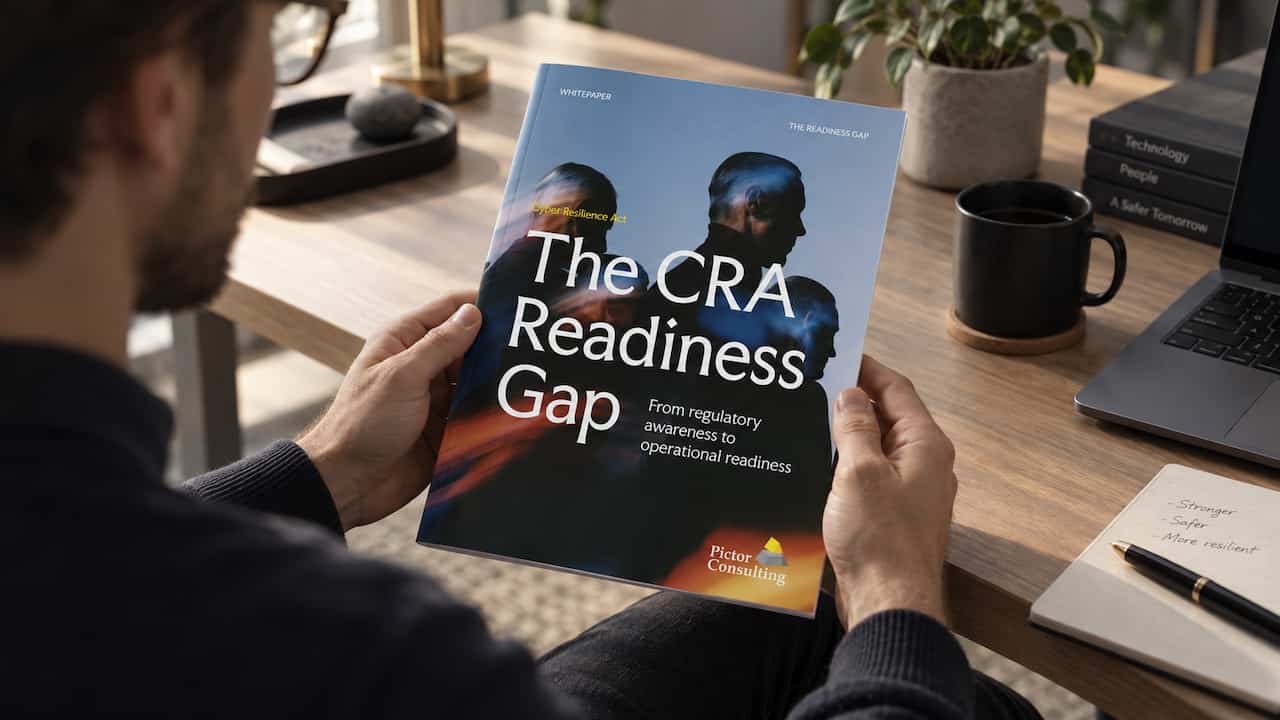
FEATURED WHITEPAPER
Many organisations understand the regulation but have not yet turned it into ownership, engineering routines and evidence. This practical whitepaper shows how to close that gap.
TRACEABILITY
Pictor Consulting keeps risk, architecture decisions and verification connected, so the argument holds under review.
01
Product, programme, roles and applicable requirements.
02
Safety hazards, cybersecurity risks and prioritisation.
03
Requirements, design decisions and mitigations.
04
Reviews, tests, actions and acceptance criteria.
05
Traceable records, technical documentation and decision rationale.
WHEN ORGANISATIONS CALL
Most engagements start in one of these, and widen once the evidence chain is visible.
A senior safety or compliance role needs to be filled quickly without losing momentum.
CRA requirements must be translated into real engineering, documentation and post-market processes.
Risk, architecture, decisions and verification need a defensible line of traceability.
RESEARCH BACKGROUND
Assurance, modelling and safe cooperation between connected systems — applied research that informs how we structure evidence.
CELTIC-NEXT
5G-enabled healthcare use cases across hospital, home and emergency environments.
RISK · ENGINEERING · EVIDENCE
The Pictor Consulting symbol is how we work. Risk at the base, engineering decisions in the middle, evidence at the signal layer — each one carrying the one above it.
RISK
We start where the consequences are: hazards, threats and the operating context. Risk work that is explicit enough to steer design decisions, not a document produced after the fact.
ENGINEERING
Requirements, architecture and verification treated as one chain. Safety and security requirements are allocated to real components, with rationale kept where the design lives.
EVIDENCE
The signal layer: an assurance case where every claim resolves to an argument and an artefact. Structured so an auditor, a notified body or a customer can walk the same path you did.
CRA, machinery, medical and automotive frameworks translated into concrete engineering obligations — with the reasoning kept visible.
Interim safety and security management: cadence, review gates and the authority to make evidence part of the plan rather than the aftermath.
Methods, templates and review habits handed over to your own teams, so the practice continues after the engagement ends.
CRA SCOPE CHECKER
Enter your website. We read what you make and sell, then ask only the few questions the regulation turns on.
About 60 seconds. No account. PDF report on request.
INSIGHT